


Camilo Lazo | Presidente Nacional de la Partido Laborista Estadounidense–
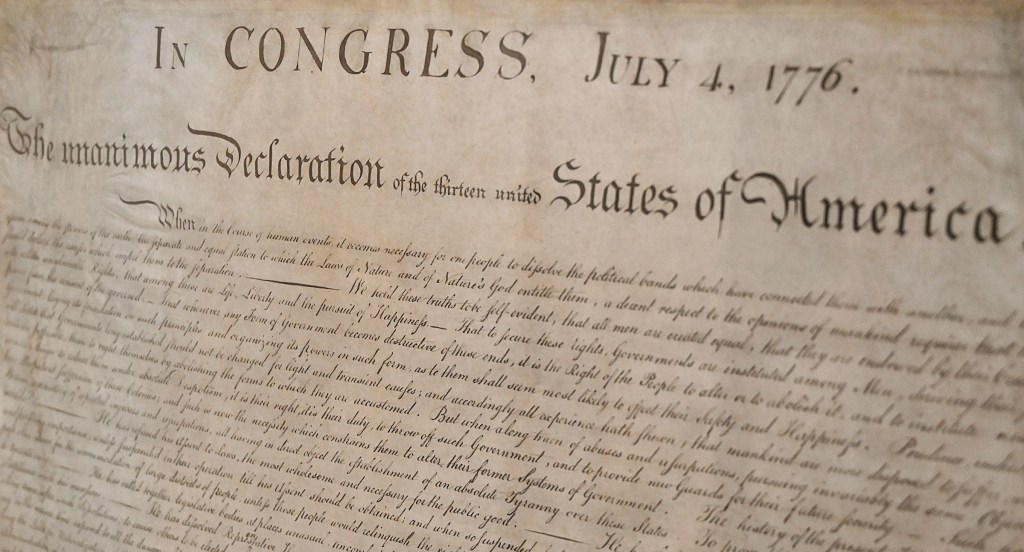
On July 4th, Americans will once again gather beneath the “bombs bursting in air,” surrounded by the aroma of grilling bratwurst, while bourgeois politicians of every stripe wrap themselves in the language of “liberty,” “democracy,” and the “Founding Fathers.” Yet scarcely will the charcoal embers have cooled and faded before the familiar divisions of contemporary American society reappear. Some will have celebrated the 250el anniversary of American Independence as proof of the nation’s exceptional greatness. While others will have condemned the Revolution as the beginning of an empire built upon slavery, Indigenous genocide, and capitalist exploitation. Still others will have insisted that the “true meaning” of 1776 was betrayed by executive power, political polarization, and bitter disputes over immigration, federal authority, and the limits of constitutional government.
That these profoundly different interpretations should emerge during the 250el Anniversary of the American Revolution should surprise no one. Revolutions, unlike ordinary historical events, seldom remain in the past. They continue to serve as battlegrounds upon which later generations contest their own political aspirations and conflicts. The American Revolution is no exception to this maxim.
What is remarkable is not that Americans disagree over the meaning of 1776, but that they have so often imagined they do not. The Revolution has long occupied an almost sacred position within American civic religion. Schoolchildren were once compelled to memorize Jefferson’s plagiarized prose – lifted from John Locke. Flags adorned front porches. Military flyovers accompanied Independence Day celebrations. Unlike the French Revolution, whose every anniversary revives arguments over Robespierre, the Terror, and the Republic, the American Revolution has often been presented as a finished chapter whose moral conclusions are “self evident.”
Yet beneath this veneer of consensus lies a conflict every bit as enduring as that surrounding 1789. Was the Revolution fundamentally a struggle for universal human liberty? Was it principally a revolt of colonial elites protecting their economic interests? Did it inaugurate democratic progress, or merely replace one ruling class with another? Such questions have occupied historians for generations because they remain questions not about the past, but about the present.
Historical interpretation rarely develops in a political vacuum. Every generation rewrites the Revolution according to its own experiences. Historians writing amid the optimism of the Progressive Era saw democratic reform. Those shaped by the Depression emphasized economic conflict. During the Cold War, the Revolution offered as evidence of liberal democracy’s inevitable triumph over the “Evil Empire.” More recent scholars, influenced by civil rights movements, feminism, Indigenous history, and labor struggles, have expanded the Revolution’s narrative to include voices once excluded from the traditional account.
As with most historical events, three broad schools of interpretation have emerged. They may be termed Conservative, Liberal, and Marxist. These are not rigid categories, nor do all historians fit neatly within them, but each reflects a distinct understanding of what the Revolution accomplished and whose interests it ultimately served.
For conservatives, the American Revolution represented the successful defense of inherited constitutional liberties rather than the creation of an entirely new social order. Unlike the upheaval in France thirteen years later, the American Revolution is viewed as moderate, prudent, and respectful of tradition. British historian and parliamentarian Edmund Burke himself, who denounced the French Revolution in uncompromising terms, expressed considerable sympathy for the American colonists, precisely because he believed they sought to preserve the historic rights of Englishmen rather than “overturn civilization.” From this perspective, the Constitution, limited government, private property, and ordered liberty constitute the Revolution’s enduring achievements. Contemporary conservatives often invoke 1776 as a warning against excessive governmental power while simultaneously emphasizing national unity, patriotism, and constitutional continuity.
Liberal historians have generally regarded the Revolution as the birth of modern democracy. They celebrate the Declaration of Independence as humanity’s first great proclamation of rights – conveniently forgetting past examples such as the Roman Twelve Tables, and the Medieval Magna Carta — while acknowledging that these ideals were imperfectly realized. Slavery, property qualifications, the exclusion of women from political life, and the dispossession of Native peoples appear as “tragic contradictions” rather than defining characteristics. The Revolution established principles that later generations would gradually extend to all Americans through abolition, Reconstruction, women’s suffrage, labor reform, and the civil rights movement. In this interpretation, American history is fundamentally one of continual improvement, in which the nation’s democratic promises slowly catch up with its founding ideals.
The Marxist interpretation differs profoundly from both.
Karl Marx admired the American Revolution as one of history’s decisive bourgeois revolutions. Together with the Dutch Revolt, the English Civil War, and the French Revolution, it marked the political ascent of the capitalist class over older feudal and monarchical structures. The Revolution shattered mercantilist restrictions, weakened aristocratic privilege, expanded commodity production, and opened vast new possibilities for capitalist development. It represented an immense historical advance.
Yet for Marxists, historical progress and social emancipation are not identical.
The Revolution abolished monarchy, but not class rule. It proclaimed equality before the law while leaving intact enormous social, economic, and cultural inequalities. It denounced political tyranny while preserving slavery across much of the new republic. It established republican government, but one in which political power remained concentrated among propertied elites who both condemned and emulated their British counterparts. The bourgeoisie had liberated itself from imperial restraint, yet the working class remained economically subordinate.
This contradiction was neither accidental nor hypocritical in a simplistic moral sense. Rather, it reflected the historical limits of every bourgeois revolution. The capitalist class could destroy feudal privilege because feudal institutions obstructed the further development of productive forces. It could proclaim universal rights because commodity exchange presupposed formally equal individuals. But it could never abolish private ownership of the means of production, for its own political supremacy rested upon precisely that foundation.
The American Revolution, therefore, appears, within Marxist historiography, as both progressive and limited. It deserves neither uncritical celebration nor wholesale condemnation. Without 1776 there could have been no constitutional republic, no destruction of colonial dependency, no expansion of democratic institutions, and no subsequent labor movement capable of organizing on a national scale. Yet without its unresolved contradictions there would likewise have been no Civil War, no struggles over industrial capitalism, no great strikes of the nineteenth century, and no socialist movement.
Lenin frequently emphasized that Marxists support bourgeois-democratic revolutions insofar as they eliminate older forms of oppression and create conditions favorable to the independent organization of the working class. The proletariat cannot transcend capitalism until capitalism itself has substantially developed. Bourgeois democracy is historically superior to feudal absolutism, while remaining insufficient from the standpoint of socialism.
The historical materialist approach distinguishes Marxist historiography from both conservative nostalgia and liberal triumphalism. Conservatives often regard the constitutional settlement as essentially complete. Liberals frequently view history as the gradual perfection of existing institutions. Marxists instead understand history as an unfolding series of contradictions in which each revolutionary advance creates new forms of conflict.
The American Revolution illustrates this process with unusual clarity.
The Declaration of Independence proclaimed that governments derive “their just powers from the consent of the governed.” Enslaved African Americans asked why this principle did not apply to them. Women asked why political equality excluded half the population. Wage laborers questioned why political liberty coexisted with economic dependency. Indigenous peoples rejected the assumption that republican expansion justified the seizure of their lands. Every democratic advance generated further democratic demands.
The Revolution thus produced forces extending beyond the intentions of many of its own leaders. Jefferson did not foresee industrialization. Madison did not anticipate universal suffrage. Hamilton scarcely imagined mass political parties representing millions of industrial workers. History repeatedly escaped the control of those who believed themselves to be its masters and architects.
This is not unique to America. Bourgeois revolutions habitually unleash social forces they cannot entirely contain. The French Revolution produced Robespierre and Babeuf; the Revolutions of 1848 gave rise to Marx’s mature political thought; the Paris Commune transformed socialist strategy; the Russian Revolution emerged from contradictions generated by capitalist modernization and imperialist war. Revolutions close one historical epoch in order to open another.
The 250el Anniversary arrives amidst renewed debate concerning executive authority, federal institutions, economic inequality, immigration policy, organized labor, and the relationship between wealth and political influence. These controversies have intensified during the second administration of Donald Trump, whose presidency has renewed longstanding arguments concerning presidential power, the administrative state, constitutional limits, and the meaning of American “democracy.” To conservatives, these conflicts frequently appear as efforts to restore constitutional government against “woke” bureaucratic excess. Liberals often interpret them as threats to democratic norms and institutions. Marxists, however, see something different altogether. Not an aberration from American “ideals,” but the expression of American capitalism’s contemporary contradictions.
From this perspective, neither Donald Trump nor his political opponents constitute the fundamental subject of history. Rather, they represent competing tendencies within the same capitalist social order, with each attempting to stabilize a system increasingly characterized by concentrated wealth, declining confidence in institutions, and widening social inequality. Elections determine governments; they do not, by themselves, resolve underlying class antagonisms.
Yet this should not be mistaken for fatalism. Marxist historiography has never denied the importance of political struggle. Quite the contrary. It insists that historical development occurs precisely through conflict between social classes whose interests cannot ultimately be reconciled. The American Revolution itself demonstrated this truth. The colonial bourgeoisie confronted imperial authority. Small farmers demanded greater political participation. Urban artisans pressed for democratic reforms. Enslaved people pursued freedom by every available means. Loyalists resisted revolutionary change. The Revolution was never a harmoniously triumphant national awakening, but a complex struggle among competing social forces.
Perhaps the greatest misunderstanding surrounding Marxist interpretations of the American Revolution is the assumption that it is dismissed as merely “bourgeois.” The adjective is descriptive rather than dismissive. Bourgeois revolutions transformed the world more profoundly than almost any previous historical development. They dismantled hereditary privilege, accelerated scientific progress, expanded literacy, revolutionized production, and introduced political principles whose implications would reverberate across continents. Marx and Engels praised capitalism’s revolutionary role even as they predicted its eventual supersession.
To recognize the Revolution’s bourgeois character is not to deny its historical significance, but to confirm it.
Every revolution bears within itself both achievement and limitation. The American Revolution abolished monarchy while preserving slavery. It proclaimed universal rights while excluding millions from political participation. It founded representative government while entrenching private property. It inaugurated democratic politics while simultaneously laying the institutional foundations for history’s most dynamic and oppressive capitalist societies.
Its legacy is necessarily contradictory.
Conservatives remember order, constitutionalism, and national independence.
Liberals celebrate rights, democracy, and expanding inclusion.
But, Marxists recognize all these achievements while emphasizing that the Revolution’s very success created new contradictions that later generations would struggle to overcome.
Two hundred and fifty years after Lexington and Concord, the American Revolution remains, in a sense, unfinished. Not because independence has yet to be won, or because monarchy threatens restoration, but because the social questions raised by the triumph of bourgeois democracy continue to shape political life. Liberty without equality; political citizenship alongside economic inequality; formal democracy amid concentrated wealth. These were not historical accidents but structural features of the new bourgeois republic.
In the end, every generation rediscovers 1776 according to its own circumstances. The Revolution has become less an event than the language through which the Americans bourgeois establishment, of both varieties, debates itself. Like all revolutions, it belongs simultaneously to the past, to the present, and to the future.
Historians may date the American Revolution from 1765 to 1783, or from Lexington to the ratification of the Constitution. Such chronological boundaries are indispensable for textbooks.
History itself is less accommodating.
The guns fell silent at Yorktown.
The debates did not.
Nor will they ever.