The LGBTQIA+ Commission of the American Party of Labor—
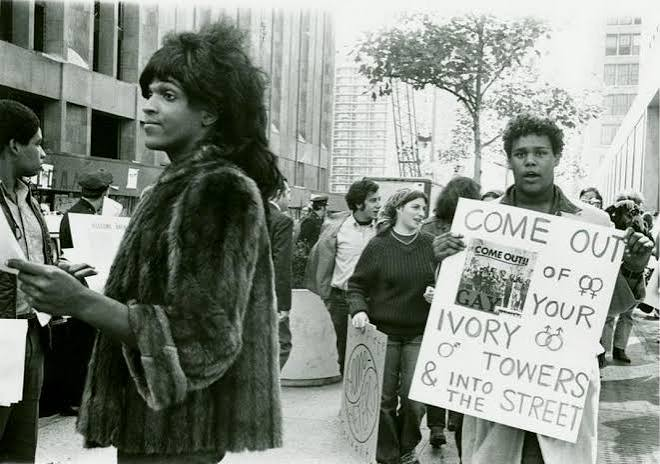
Ever since the days of the first Christopher Street Liberation Day, Pride Marches have historically been organized as political, and explicitly radical events. Given the attacks made by the Trump regime and resulting outbreaks of right-wing terror against LGBTQIA+ people and especially transgender people, it must be said that for Pride events to have any genuine meaning, they must be both celebrations and extensions of the militant struggles of our community. The proliferation of corporate Pride events sanitizes that history and blunts the political consciousness of the movement for queer liberation. Through the sponsorship of large capitalist interests, the presence of and even recruitment by law enforcement, and the open platforming of bourgeois politicians, many contemporary Pride events have completely divorced from their original purpose. At a time where the precarity of our communities has never been more intensified, LGBTQIA+ workers must ask ourselves what it is that we want from Pride gatherings. Do we want simple vendor fairs with a rainbow tint, or do we want events that represent the genuine needs of our communities? It is critical that we ask these questions if we do not wish for the trajectory of the LGBTQIA+ liberation movement to be set in favor of interests that do not align with the needs of the overwhelming majority in our communities.
The first Pride March, originally referred to as the Christopher Street Liberation Day, was held in 1970 to honor the first anniversary of the Stonewall Uprising. While the uprising has become a cornerstone of LGBTQIA+ cultural history, the sheer scale and militancy of the event has largely been lost. Beginning on the evening of June 28 and continuing through to July 3 1969, over 1,600 LGBTQIA+ people and their supporters rose up against both police repression and mob exploitation perpetrated in the Stonewall Inn, a gay bar in the Greenwich Village neighborhood of New York. During the uprising over 5,000 leaflets calling for the liberation of Christopher Street and the expulsion of the police and mafia from gay bars were distributed by agitators. In the aftermath of the uprising, several organizations were formed to direct the momentum of Stonewall into continuous radical political action. These included the Gay Liberation Front (GLF), Gay Activists Alliance, and Street Transvestite Action Revolutionaries (STAR) all of which were integral in organizing the first Pride events.
For the next two decades, the explicitly political and community based context of pride events largely remained unaltered in many cities. This was especially important during the AIDS epidemic beginning in the 1980s and the accompanying abandonment of the LGBTQIA+ community by the American Government. However this changed fairly rapidly beginning in the 90s, as various capitalist interests began to sponsor pride events in a bid to appeal to what was seen as an “underserved market.” At the same time, a small but vocal network of petit-bourgeois proprietors among the queer community began to form regional LGBTQ chambers of commerce with the intent of advocating for their business interests. These chambers of commerce maintain an outsized presence at many local Pride events.
As the influence of both large corporate sponsorship and local petit-bourgeois interests over pride events grew, the emphasis on the needs of poor and working class LGBTQIA+ people, who make up the majority of our community, has decreased. One of the more glaring examples of this trend can be seen by the acceptance of police presence at pride events. Despite Pride explicitly being a celebration of an oppressed minority uprising against the police, contemporary events, particularly during the Biden administration, began to openly celebrate police presence.
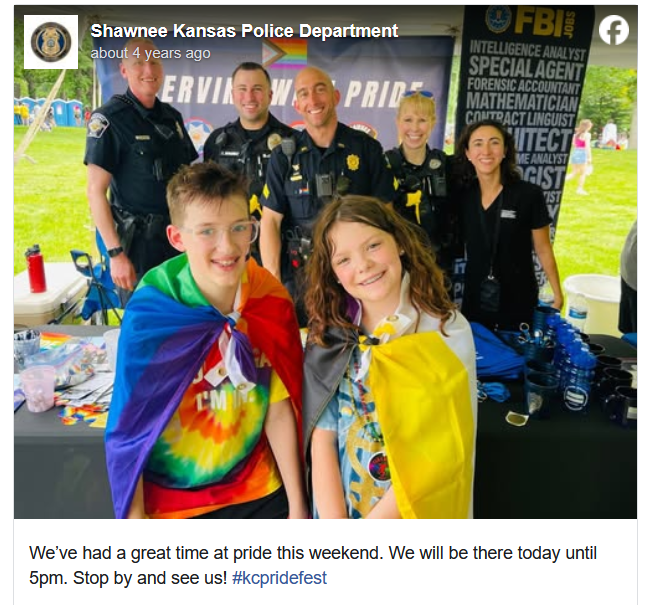
At the 2022 Kansas City Pride, multiple police departments as well as the FBI were even allowed to hold a recruitment drive. While a handful of particularly reactionary city officials bemoaned this decision, it was largely celebrated in the liberal press as a victory in the struggle for LGBTQIA+ rights. And yet we can be forgiven for asking what has the acceptance of capitalist influence and police presence actually gained for our communities?
The advent of the second Trump regime has coincided with the large-scale abandonment of Pride events by many corporate sponsors. 2026 saw as much as a 50% reduction in sponsors for some events. As more companies fear a tangible financial backlash against being associated with LGBTQIA+ communities, they have proven what we should have always known: their support is always contingent on the ability to extract profit. Has the support of law enforcement proved to be any more reliable? Queer people are in fact nearly six times as likely to experience police harassment than the general population. And while that is unsettling, the unknown abuse is far more so. Starting in January, the U.S. Department of Justice began removing data analyzing any violence against transgender people thus ensuring that continued violence will largely go unreported.
What can be done in the face of these admittedly bleak developments?
In the weeks following the Stonewall uprising, the GLF distributed leaflets that read: “Do you think that homosexuals are revolting? You bet your sweet ass we are!” It is clear that nothing has been gained from abandoning the radical roots of Pride. The active courting of corporate sponsors, collaboration with the police and platforming of bourgeois politicians has only deprived our communities of their ability to fight against our oppressors. In the midst of the brutal attacks by the Trump regime, we must both reclaim that history of struggle and strengthen it further by connecting it to the struggle of all oppressed peoples. Pride does not belong to the capitalists, nor does it belong to the ineffectual liberal politicians who have failed to meaningfully stand with us. It certainly does not belong to the police. Pride belongs to the workers, and its place is in the streets.