


Meyer K. | Red Phoenix Correspondent | New York–
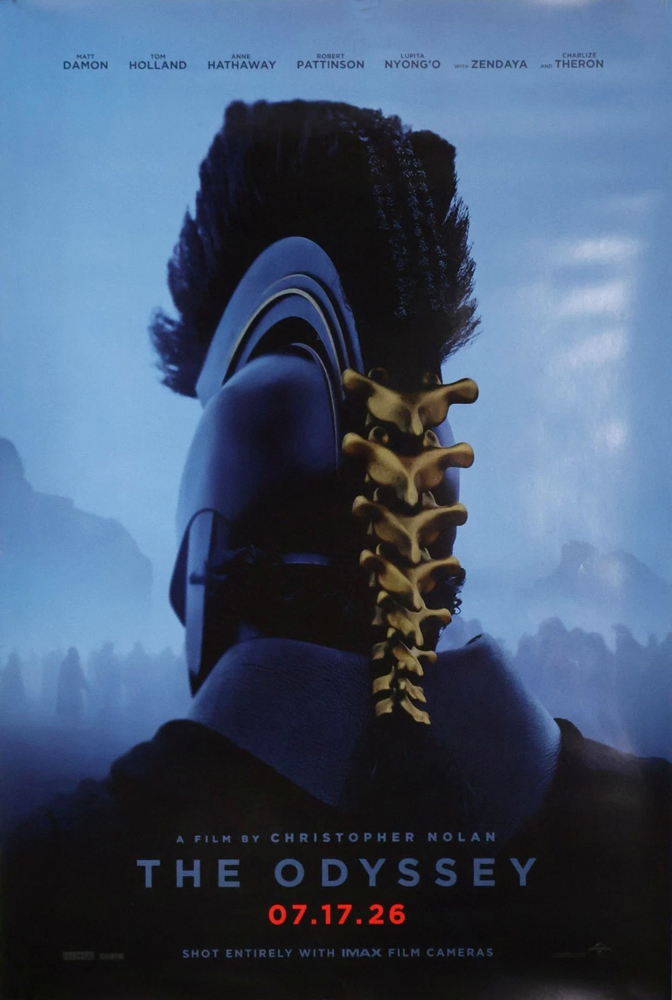
Few films this year have generated as much controversy and discussion as Christopher Nolan’s The Odyssey. A modern adaptation of an ancient poem which traces its lineage back to the 8th or 7th century BCE, it was sure to draw attention. However, despite this scrutiny, the discussion surrounding the film since even before its release has been shallow, if emotionally charged, with the sharpest attention being paid to casting choices, which are either condemned as “woke” or lauded as “progressive.” In this way, the film had served its primary function as a distracting spectacle before the curtains ever rose.
The reactionary backlash surrounding the decision to cast Lupita Nyong’o as Helen and Clytemnestra, alongside Elliot Page as Sinon – while unsurprising – seems especially absurd now after the release of the film. Although Nyong’o played both Helen of Troy and Clytemnestra her allotted lines allowed only for “a set of all too brief tableaux of female victims (the bereaved mother, the abused wife),” as noted by Emily Wilson, the translator of the edition which inspired Nolan’s adaptation. Similarly, Penelope (played by Anne Hathaway) speaks to her son regarding her dedication to the well-being of the kingdom and her aptitude to govern, denouncing the sexist exclusion which prevents her from occupying the throne. However, when Odysseus (Matt Damon) later returns to the estate, disguised as a beggar, this plot-point is forgotten. The women in the movie are all cardboard cut-outs. The same goes for Sinon.
The prominence of the aforementioned actors and cast members of marginalized backgrounds more broadly in teaser trailers and promotionals, contrasted with the extremely limited screen-time they receive in the film, raises questions concerning the film’s public relations strategy, which appears to have been cynically crafted to generate reactionary media outrage to profit from the ensuing controversy. Even if this disparity was only due to run-time concerns (maybe especially in this case) the decisions remain indicative of the studio’s priorities. The movie is thus a perfect example of the contemporary consumer-spectacle; both politically and culturally. The film has succeeded at the box-office so spectacularly precisely because it so perfectly fits the mold of “mass-culture.” Critics who call Nolan’s movie “genius” or treat it as a political force in itself, demonstrate this fact and reaffirm Cardew’s formula that: “Today, in the period of the collapse of imperialism, any pretensions to artistic genius is a sham.”
Mass-cultural products are a specific type of cultural product, made by the capitalist class. It is not the natural product of organic, popular desires, but it works to define those desires through repetition and suggestion, using these fabricated desires to ideologically influence the masses. The repertoire of artistic expression is increasingly restricted under these conditions, reduced to a number of tropes and stereotypes and specified genres which are easily commodified. The directors of the mass-culture industry not only cater to the public taste, they actively shape it according to the necessities of imperialist consumerism. The principal purpose of the spectacle is to pacify the worker’s movement, either by utilizing marketing and the “attention economy” to subdue the working class with cheap sensationalism or by distracting it with calls for pseudo-involvement. To this end they turn to logomachy (rhetorical arguments), televised debate, consumer boycotts, bourgeois elections, bourgeois cultural “radicalism”; all create an appearance of political mobilization and democracy but are entirely devoid of true democratic content. The Odyssey is a rousing success on all these grounds.
Furthermore, the film participates in the bourgeois tradition of barely noticeable technical innovations. It was recorded on 15-perforation, 65mm IMAX film cameras and made use of new filming techniques to do so (which many movie-theaters were unable to play as intended, anyhow). In this way, Nolan succeeded in simulating a semblance of artistic innovation and continuity, while at the same time taking no risks. Nolan even collaborated with IMAX in order to produce a new generation of IMAX cameras in connection with the film, turning the film and its success into an implicit advertisement for this labor-intensive technology and the hardware necessary to play it. He even goes a step further in integrating The Odyssey into capitalist imperialism by filming a handful scenes in the Moroccan-occupied Western-Sahara near the coastal city of Dakla amidst the ongoing genocide of the native Sahrawi people by the U.S.-backed Moroccan government, while accepting subsidies from the Moroccan government to do so. Morocco maintains near total suppression of press and media within the region, and the film helps to whitewash the situation by normalizing increased investment by American capitalists. A signatory of the Abraham Accords, Moroccan sovereignty over the region is only recognized by two countries: the U.S. and Israel. This “creative decision” stains the film with blood by allowing it to become a propaganda coup for Trump-era U.S. imperialism and its proxies by normalizing the Moroccan government’s right to monetize and develop the area.
When Odysseus arrives, he disguises himself as a beggar and nobody is surprised to see a new beggar around. What does this say about the state of the kingdom, about Odysseus as sovereign? So much was already changed from the source material: the gods are largely missing or toned down, the lotus eaters have taken on a benevolent framing, Agamemnon’s armor has been styled according to the aesthetics of a Batman film. Why persist in the positive presentation of slavery?
Even the “anti-militarist” message of the film is weak, psychologizing the phenomenon and mystifying it in doing so. Odysseus is portrayed as proud and antagonistic, pulling others into violent encounters primarily because of his hubris and pride. This idealistic understanding of violence ignores the class interests behind all war and imperialist expansionism. We are invited to relax and gawk at the non-linear story telling, a worn-out trope which is just busy enough to make the audience feel clever without ever really forcing it to wrestle with transgressive ideas. We are expected to appreciate the simplification of Odysseus, whose infidelity and arrogance in the source material would’ve made for a less-relatable protagonist in the film. We are expected to swallow the normalization of bourgeois “good guys and bad guys” without questioning whether those interests align with our own.
The purpose of the spectacle, and of mass-culture more generally, consists in obscuring the material drivers behind history and demobilizing the masses. Marxist-Leninist criticism must expose the false-consciousness smuggled into the consumer spectacle, and draw clear lines of demarcation between it and proletarian art; which the masses must make for themselves.
Works Cited
Cardew, Cornelius. Stockhausen Serves Imperialism. London/New York, Primary Information, 1974/2020.
Wilson, Emily. “An Uncomplicated Man.” London Review of Books, vol. 48, no. 14, 2026. London Review of Books, https://www.lrb.co.uk/the-paper/v48/n14/emily-wilson/an-uncomplicated-man. Accessed 17 August 2026.