

Viktor Orbán’s right-wing nationalist Fidesz party has been defeated. It has been replaced by Péter Magyar, a man who comes from the same political camp as his predecessor – yet differs from him on one crucial issue.
Arbeit Zukunft| Apr. 17, 2026 | Translated for the Red Phoenix by Misha G.–
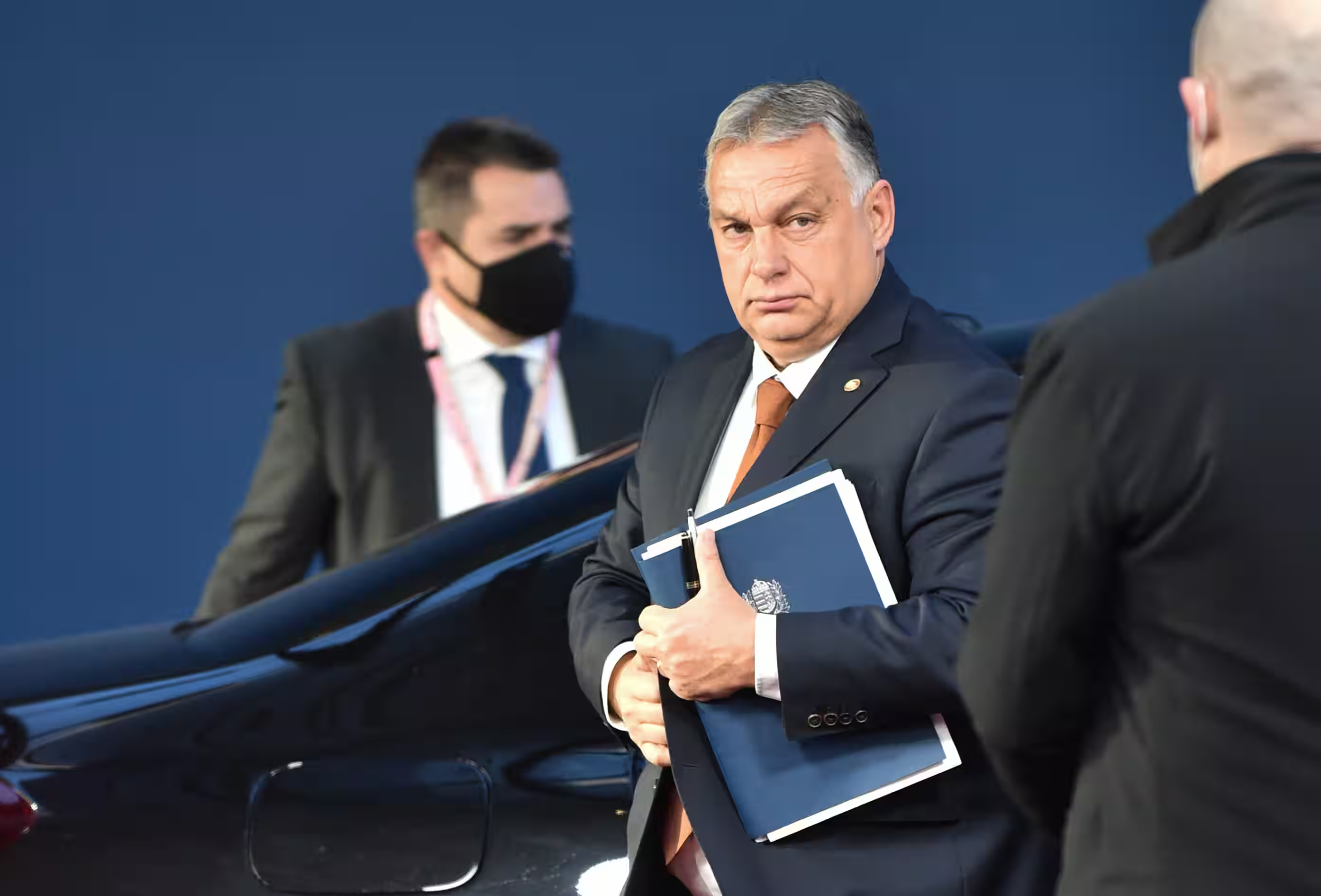
Viktor Orbán’s 16 years of power as the extreme right-wing prime minister of Hungary came to an end on Apr. 12 when he lost the election to Péter Magyar. A great deal has been made about this, but is this really a “return to democracy”?
Magyar was himself a longtime member of the Orbán system before breaking with the party around two years ago. Today, he leads the opposition, centered around the Tisza party which is seen as a political up-and-comer and “renegade.” Instead, the Tisza party represents less of a fundamental change of course than a shift along the same right-wing nationalist spectrum.
On key domestic policy issues, Magyar remains close to Orbán’s line. This is particularly true regarding migration policy, which is virtually identical. Orbán, who has described migrants as a “poison,” has even been criticized by the Tisza party for allowing too much labor migration!
So what is the difference? The crucial difference lies in foreign policy: Magyar positions himself much closer to the EU and distances himself from Orbán’s pro-Russian stance. For example, he supports the EU loan of around 90 billion euros to finance Ukraine, but emphasizes that Hungary itself should not be a contributor. At the same time, he advocates increasing pressure on Russia and especially on Vladimir Putin.
This very realignment of foreign policy is the real reason for the positive assessment of him in many leading Western media outlets. In fact, according to them, Hungary has returned to “democracy” and “Western values.” “Election Sunday in Hungary was a good day for liberal democracy in Europe,” writes the German newspaper Handelsblatt!
In reality, it is less a fundamental political break than a departure from a line that had increasingly become an increasingly disruptive factor for the leading forces within the EU. All EU members of course must be strictly in line with the imperialist interests of the dominating countries in the EU.
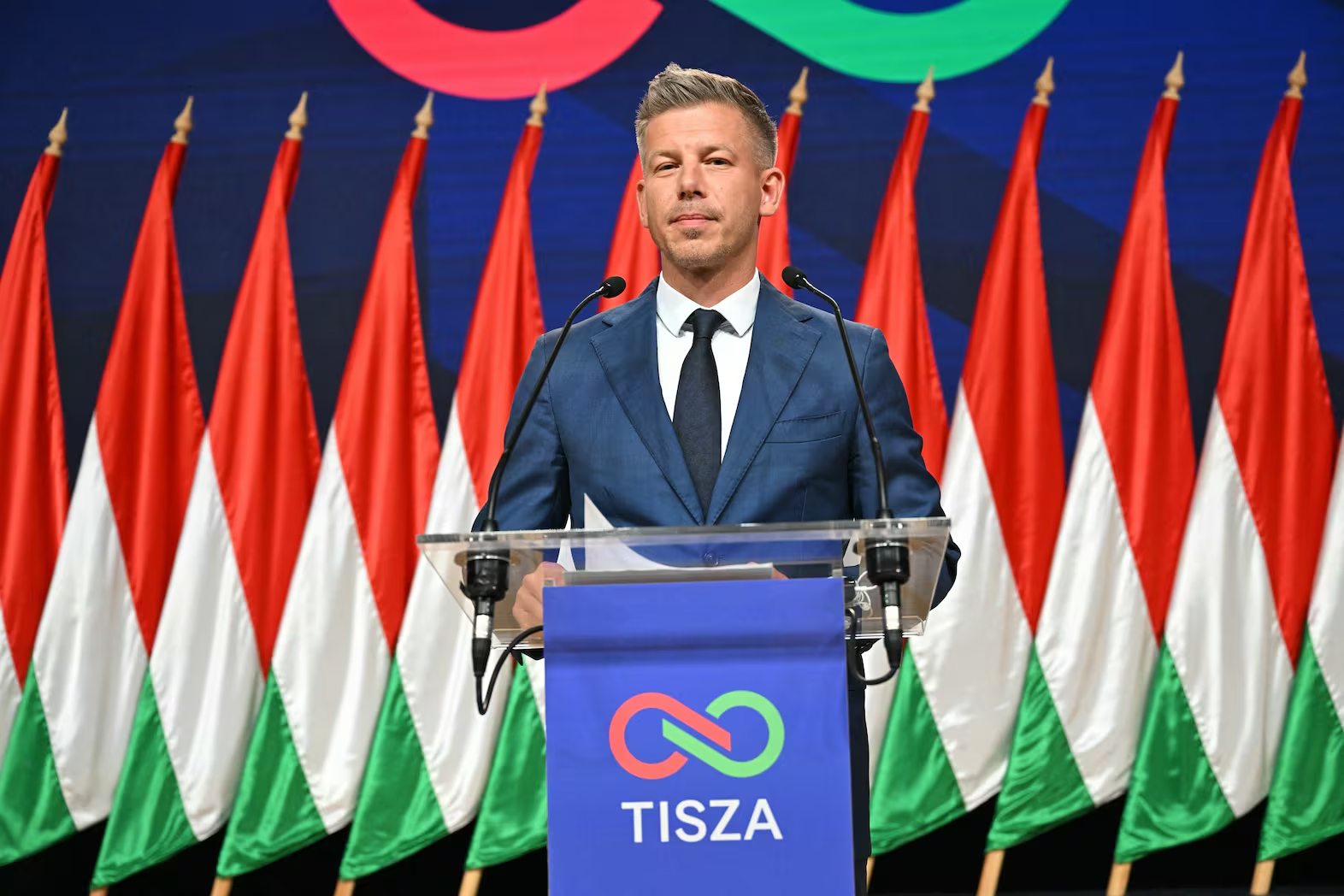
Magyar’s success, however, cannot be explained solely by his foreign policy position. The historic voter turnout of around 80 percent, as well as the result – 52.1 percent for Tisza compared to 39.5 percent for Fidesz – show that a clear majority of the population wanted change.
The decisive factor in this large turnout is primarily the economic situation which is characterized by high inflation, low wages, a dilapidated healthcare system, and a corrupt elite enriching itself while large sections of the working class are increasingly under severe economic pressure. Although Hungary experienced strong economic growth between 2013 and 2020, this was largely due to the fact that Hungary offered very favorable investment and exploitation conditions for Western European imperialist corporations, particularly the German automotive industry. However, the pandemic and the subsequent crisis following the war in Ukraine led to a significant downturn. The result was a noticeable impoverishment of large segments of the working class and the rural population.
While the corruption of the Orbán elite was begrudgingly tolerated during periods of relative growth, it became more and more seen as a central problem by large segments of the population under the increasingly difficult social conditions. This is precisely where Magyar focused his efforts: his pledges in the fight against corruption struck a chord with society. At the same time, the Tisza leadership deliberately avoided presenting itself as overly pro-Western and emphasized the EU primarily for resolving financial, rather than ideological, issues. Magyar also consciously avoided addressing topics such as LGBTQ rights so as not to alienate conservative voters. During the election campaign, he portrayed Orbán as out of touch – as someone who had lost touch with “real” Hungarians, while he himself promised to focus on their interests.
Orbán, in turn, relied on support from right-wing populist allies like Donald Trump and Alice Weidel. At the same time, he clearly positioned himself on Russia’s side in the Ukraine conflict. Magyar countered that this foreign policy confrontation was damaging Hungary economically and costing it urgently needed EU funds – while the Orbán elite was simultaneously enriching itself and controlling key institutions such as the media and the judiciary.
Tisza announced plans to “liberate” the economy through market-oriented reforms and to focus more strongly on national development. In addition, social measures were promised, to be financed with EU funds that had recently been frozen. It should be clear that this will not be enough to noticeably improve the social situation.
Despite all this propaganda, similarities between Orbán and Magyar are already emerging. Besides the continuation of a racist migration policy, there are strong indications of an adherence to anti-worker and anti-union laws introduced under Orbán’s party, Fidesz. Personnel decisions also point in this direction: With István Kapitány (former exec of Shell) and Anita Orbán (formerly an advisor to the US Liquified Natural Gas exporter Cheniere), Tisza is relying on business-friendly “experts.” What is astounding is that this course is presented as a break with the previous cronyism! However, these are only new lobbyists close to capitalism who will defend the interests of capitalists and plan further anti-worker measures.
Reactions in Germany
In Germany, the election result was received predominantly positively. Right-wing populist Friedrich Merz spoke of a defeat for right-wing populism and expressed his relief. At the same time, he emphasized the supposed resilience of democratic societies to Russian influence and propaganda. Lars Klingbeil expressed a similar view, interpreting the result as a decision for democracy and Europe – and simultaneously as a defeat for Vladimir Putin.
Support also came from parts of the left. Martin Schirdewan welcomed Orbán’s defeat, while Elif Eralp, the Left Party’s lead candidate in Berlin, even used the election result for her own campaign! “The future can be changed! Metropolises like Berlin and Budapest must become centers of civil society, diversity, and solidarity,” Eralp wrote on Instagram.
These interpretations, however, hardly reflect the actual balance of power in the Hungarian parliament. Even after the election, right-wing parties dominate parliament: 139 of the 199 seats go to Tisza, 55 to Fidesz, and another six to the far-right “Our Homeland” movement. Therefore, there is no evidence of a fundamental political break.
Even the reference to Russia is, at best, only half the story. While Russia is losing an important ally within the EU with Orbán’s departure, the election in Hungary also marks a clear defeat for US imperialism. The importance of Orbán’s continued power to US imperialism is demonstrated by the fact that Trump’s Vice President, JD Vance, traveled to Hungary specifically to support Orbán’s campaign. In its most recent paper on US security strategy, the Trump administration explicitly identified the fragmentation of the EU as a desired goal. A central element of this strategy was to rely on EU-critical, right-wing populist forces in Eastern Europe. And the most central of these forces was Orbán’s Fidesz party. Simultaneously with the distancing of many Western European EU countries in the wake of the Iran nuclear deal—most notably Spain, but also, to a lesser extent, France, Great Britain, and even Italy—the US is now also losing ground on the European continent.
The main beneficiary of the election is therefore primarily the EU, led by the Western European imperialists Germany and France. With Orbán’s departure, a government considered a key disruptive force disappears and is replaced by one that places greater emphasis on closer ties with the EU. However, the extent of this shift in policy remains to be seen – not least because Tisza has, in the past, held similar positions to Fidesz on certain issues. Magyar will attempt to exploit the Ukraine question for political maneuvering and to support EU policies, provided the price is right.
EU strategy and shifting power dynamics
The election simultaneously exposes the weakness of the Hungarian left and the deep crisis of Hungary’s working class. An independent political force of the working class played virtually no role. Instead, many of the remaining, and in some cases marginal, forces subordinated themselves to the goal of ousting Orbán.
In Brussels, the center of the EU, the election results are being strategically analyzed. Ursula von der Leyen wants to use the political momentum to push forward a key reform: moving away from the unanimity principle in the EU towards qualified majority voting. A project long pursued by German imperialism to increase its power in the EU, in particular, could thus gain new momentum.
This would further shift the balance of power within the EU – away from the ability of individual states to block key decisions, towards more centralized decision-making structures – in favor of a Europe under German leadership. The election outcome in Hungary should therefore not be interpreted solely as a national event, but as part of a larger debate about the future direction of the European Union.