

Editors’ Note: On June 1, 2026, the National Coordinating Committee of Education Workers union (CNTE) in Mexico went on strike. The CNTE is a Mexican militant labor union of teachers founded 1979 by rank and file teachers in response to the dominant teacher union SNTE’s widespread bureaucratism and capitulation to the state. The central demands of this strike include the repeal of the controversial ISSSTE law, which privatized teachers’ pension funds and significantly raised the barriers to retirement. Although President Claudia Sheinbaum pledged during her campaign to repeal the law, her administration has still not done so. Striking teachers are also demanding substantial wage increases, arguing that current salaries are insufficient to provide a decent standard of living, as well as the reversal of a series of education reforms that have expanded privatization within the education system and undermined the rights of both teachers and students.
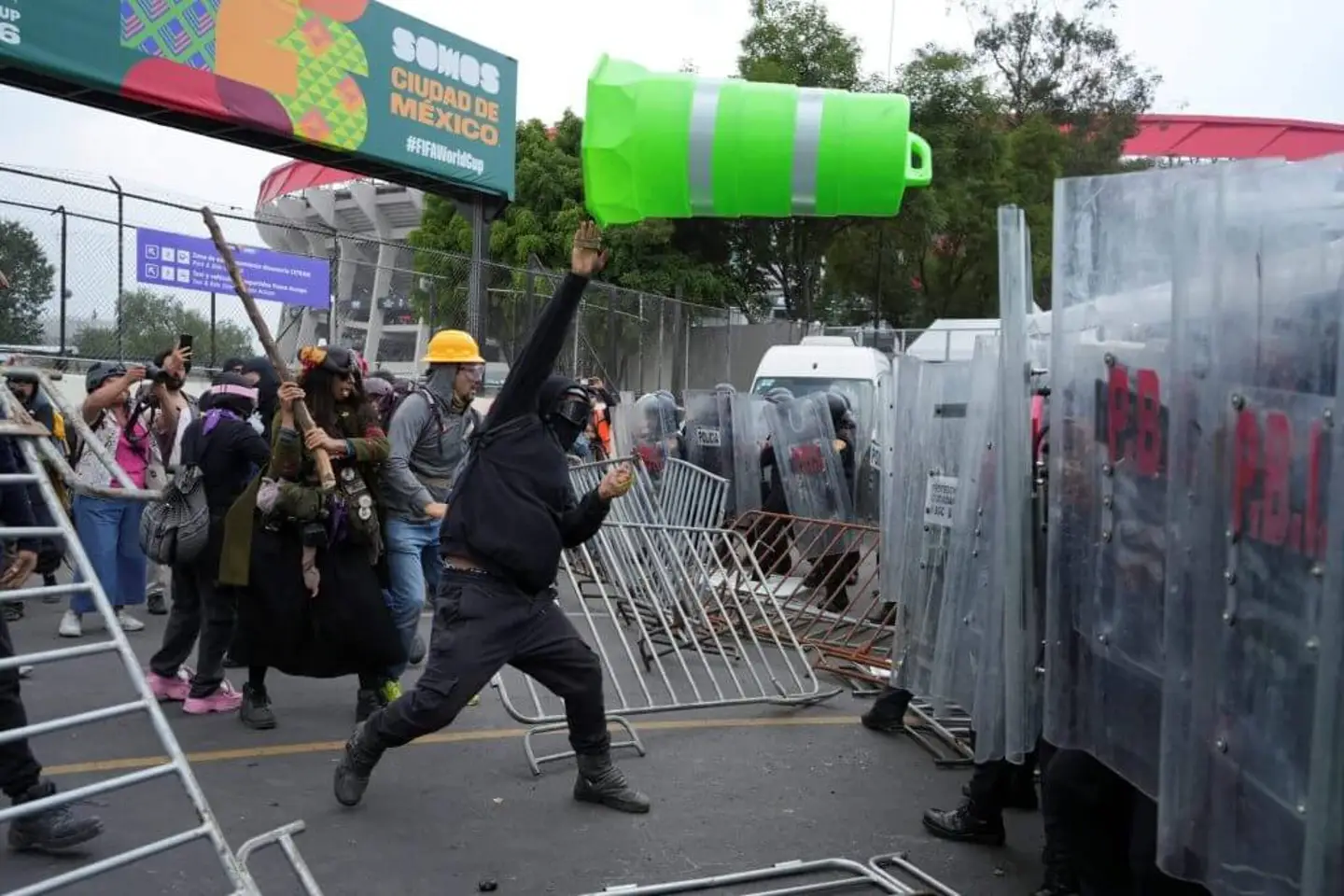
In response to the demonstrations of the teachers, the union has faced serious police repression resulting in the beating and teargassing of many striking teachers and their allies, including students and community and family members. The union has since escalated its demonstrations, and is now targeting the World Cup games in Mexico City, Guadalajara, and Monterrey.
The World Cup has seen massive investment but none of the profits will reach the working people of Mexico. The government has spent millions of dollars beautifying the streets of Mexico City that tourists will see while kicking out native residents. This has sparked outrage within the working-class community of Mexico City. This comes in the midst of the country’s ongoing crisis of “disappearances.” Mothers of the disappeared have condemned the government’s decision to spend millions of dollars on a sporting event while thousands of families continue searching for missing loved ones. They say that the government has failed to adequately address the epidemic of disappearances.
The CNTE has united with these powerful working-class forces to disrupt the World Cup and force the government to confront the pressing needs of the people. By threatening the profits of corporations and political interests set to benefit from the tournament, they seek to make it impossible for the authorities to ignore their demands. This is the current situation.
Vanguardia Proletaria #721 | June 1-15, 2026 | Translated for the Red Phoenix–
As in every broad and united front of the working class, a sharp political and ideological struggle is taking place within the National Coordinating Committee of Education Workers union (CNTE) between democratic and revolutionary positions on one side and reformist, conciliatory positions aligned with the government on the other. These ideological battles, which reflect contradicting class interests, determine the direction of the national democratic teachers’ movement: either toward containing and moderating the workers or toward strengthening the organization of the working-class and the struggle for its demands.
In the period leading up to the outbreak of the National Strike, the reformists and conciliators within the union attempted to consolidate a balance of forces favorable to their designs of supporting the Fourth Transformation (4T) (A program initiated in 2018 with the election of President Obrador which proclaimed to end the deeply unpopular and economically devastating neoliberal period, but which has in fact continued neoliberal policies in more sneaky yet more harmful ways while proclaiming to be “progressive” – Editor). Their goal is to contain any forceful political action that could affect capitalist interests during the World Cup, an event that will generate enormous profits for the capitalist groups that monopolize that spectacle.
Yet, the attempts to conciliate to the 4T program and President Sheinbaum’s supposedly “progressive” government have been clearly been exposed as bankrupted. In 2025, when the CNTE threatened a Popular Teachers’ Strike, the call of conciliation to 4T was stronger and the strike was called off. When this happened, the State launched a counterinsurgency strategy to deny the demands of the teachers that has gone through different phases and employed different methods.
The tripartite dialogue tables which the government set up following the threat of strike in 2025 have served to entertain, distract, and loudly proclaim that dialogue exists. Yet even when agreements were signed, they were never implemented and became dead letters, failing to resolve the demands of the contingents involved. Furthermore, these negotiations do not address the CNTE’s central demands which is the repeal of the educational reform and the ISSSTE law (highly controversial and harmful pension law which moved teachers pensions into the hands of private corporations), promises that the governments of Morena made in 2018 during their campaigns but have still failed to fulfill! First, the government justified their inaction by claiming they lacked a qualified majority to pass such laws; later, they argued there were insufficient economic resources for these reforms.
The statutory sectional leadership elections are also part of a plan to distract the CNTE’s strongholds, forcing them to fight on two fronts: the national strike process and the struggle against bureaucratic union leadership, which possesses financial resources to usurp the teachers’ union structures.
The counterinsurgency campaign which the government has developed since has sought to remove from negotiating structures the most consistent and committed teacher comrades, those who firmly defend the interests of the rank and file and possess the necessary knowledge and experience to defend workers’ rights at the negotiating table. In the same vein, pro-government elements have attempted to divide the movement through consultations within the union designed to encourage internal confrontation.
Despite all these efforts aimed at breaking the CNTE’s unity and strength, the National Representative Assembly unanimously decided to launch the national strike on June 1, while also sending an advance contingent from Oaxaca beginning on May 25.
The State failed to fracture the movement’s unity and, during this period, resorted to desperate measures such as proposing that the school year end on June 5, believing this would demoralize workers who would supposedly prefer to go on vacation rather than continue the struggle. However, the proposal provoked outrage on digital media and had to be withdrawn. The teachers understood that they would face the same problems coming back next year!
Likewise, Claudia Sheinbaum was forced to retreat from her refusal to negotiate with any contingent of teachers. Under pressure from teachers in Chiapas, she opened direct talks with them, effectively recognizing bilateral negotiations with the union on strike.
Ultimately, as the national strike took shape and ceased to be viewed merely as a teachers’ movement, becoming instead a teachers’-and-popular movement, the government urgently reached out to social sectors it had previously neglected, such as the families of the 43 Ayotzinapa education students who were victims of forced disappearance. None of these maneuvers have worked, and the State foresees that the national strike will advance despite all its efforts.
For this reason, it has resorted to phrases used by previous more right wing regimes which it claims to break from, claiming that the protesters are “only a few people,” that “there is permanent dialogue,” and that “there is no need for a strike.” Through this rhetoric, the government seeks to gain political ground in public opinion while concealing its true intention to break the strike
The repression began to take shape on May 25 in Mexico City, when the CNTE’s advance march toward the national strike was met by more than a thousand riot police, forces that, far from disappearing, continue to carry out the task of beating and gassing social protests. The repressive offensive continued with attacks by paramilitary groups against education workers who were carrying out a peaceful political activity in Mitla, Oaxaca!
What is required now is to strengthen the national strike that will begin on June 1. To do so, we must continue organizing and conducting outreach work, counteracting the effects of counterinsurgency wherever the CNTE and popular discontent allow us to take advantage of this international contradictions. We must make it clear to the so-called “left wing populist” governments of Mexico and Latin America that it is not enough to hold forums on democracy while failing to fulfill promises to the working class. Only the workers united in a General Strike can bring about a real transition which will firmly end neoliberalism and condemn it to the dustbin of history.