

Sofia D. & the Oppressed Nationalities and Ethnicities Commission of the American Party of Labor—
June 19, the day of freedom, marks the end of the old, barbaric, crisis-ridden system of racial slavery in the U.S. It marks the defeat of the endless cruelty and backwardness of the plantation system, and the emancipation of four million Black working people between 1863 and 1865.
But Juneteenth – as Manuel Salazar, General Secretary of the Communist Workers Party of the Dominican Republic, says of the October Revolution in Russia – was “the culmination of a revolutionary process”1. It is only thanks to the combined efforts of the Abolitionist circles in the North, the Union Army, and certainly, the heroic and honored military operations, rebellions, and coordination of the enslaved themselves that wrested power from the plantation owners2 and relegated them to the dustbin of history.
Of course, we have to account for the role of the Northern industrial capitalists. It is poor history to anachronistically ascribe all the great achievements of the Civil War only to the working masses. Slavery, although slotted into an external capitalist framework, internally was the same-old system of reaction and brutality that destroyed the Roman Empire and countless other societies from antiquity through the colonial era3. Therefore, the Northern industrial capitalist class, at the time, in context, was momentarily a revolutionary force, begrudgingly leading the popular masses, though only so long as it could extend its own system of subjugation: wage labor4.
These forces combined – the popular masses, the enslaved, and the Union Army, led by the Northern capitalists — underwent a revolutionary process5 and put a definite and irreversible end to chattel slavery in the U.S. First, the forward-thinking Northern capitalists, workers, and enslaved set the political and ideological stage for the abolition of slavery, circulating the demands of the enslaved for freedom, defending their cause, and organizing parts of the Underground Railroad. Next, the slave system entered crisis: the good Southern soil which had made this dated system of production profitable was drying up, and the crude and violent system of organizing the plantations was being supplanted more and more by capitalist agriculture. Old planting states like Virginia, Louisiana, and Georgia began to turn away from the industry of planting, and to the industry of slave breeding6. These conditions of economic crisis gave rise to a fierce competition with the Northern capitalists for Western territory, finally grinding the bourgeois-slaver political alliance to a halt, to a political crisis within the ruling class.
Ideological revolutionary readiness, economic crisis, and political crisis within the ruling class – these are the conditions of revolution7. The Civil War was a revolution, but it was led by the Northern industrialists, a class whose concept of liberation extended only to the freedom to sell yourself, rather than being sold by someone else8. Following the Civil War, a brutal reaction set in in the form of Jim Crow to clip the wings of the nascent democratic and popular movement of Reconstruction. This reaction was not opposed by the Northern industrial capitalists, for whom this oppression turned a very nice profit – the capitalists only cared that they could not reap the benefits of slavery, and did not care one inch about the freedom or liberation of the enslaved and Black workers themselves.
Today, the American capitalist class is everywhere the most savage and brutal oppressor, at home and abroad. It has perpetuated the most vile genocides, especially of American Indigenous, Arab, and African peoples, and is everyday committing more violent military aggressions in Latin America, Asia, and the Middle East. It has adapted the system of racism developed for upholding slavery, and advanced it into a now-muted, now-open policy of oppression and dispossession, suited to the task of managing capitalism’s growing and tumultuous crises9. It has reinforced the policies of racist oppression from the reaction of the 70s and 80s through election redistricting and termination of “DEI” programs. These are done with the aim of continuing to disenfranchise Black, Indigenous, and immigrant communities, most likely hoping to dull their political participation, to trap these communities in menial labor and prison-slavery, and to socially engineer new problems to create moral panics and incite racist pogroms.
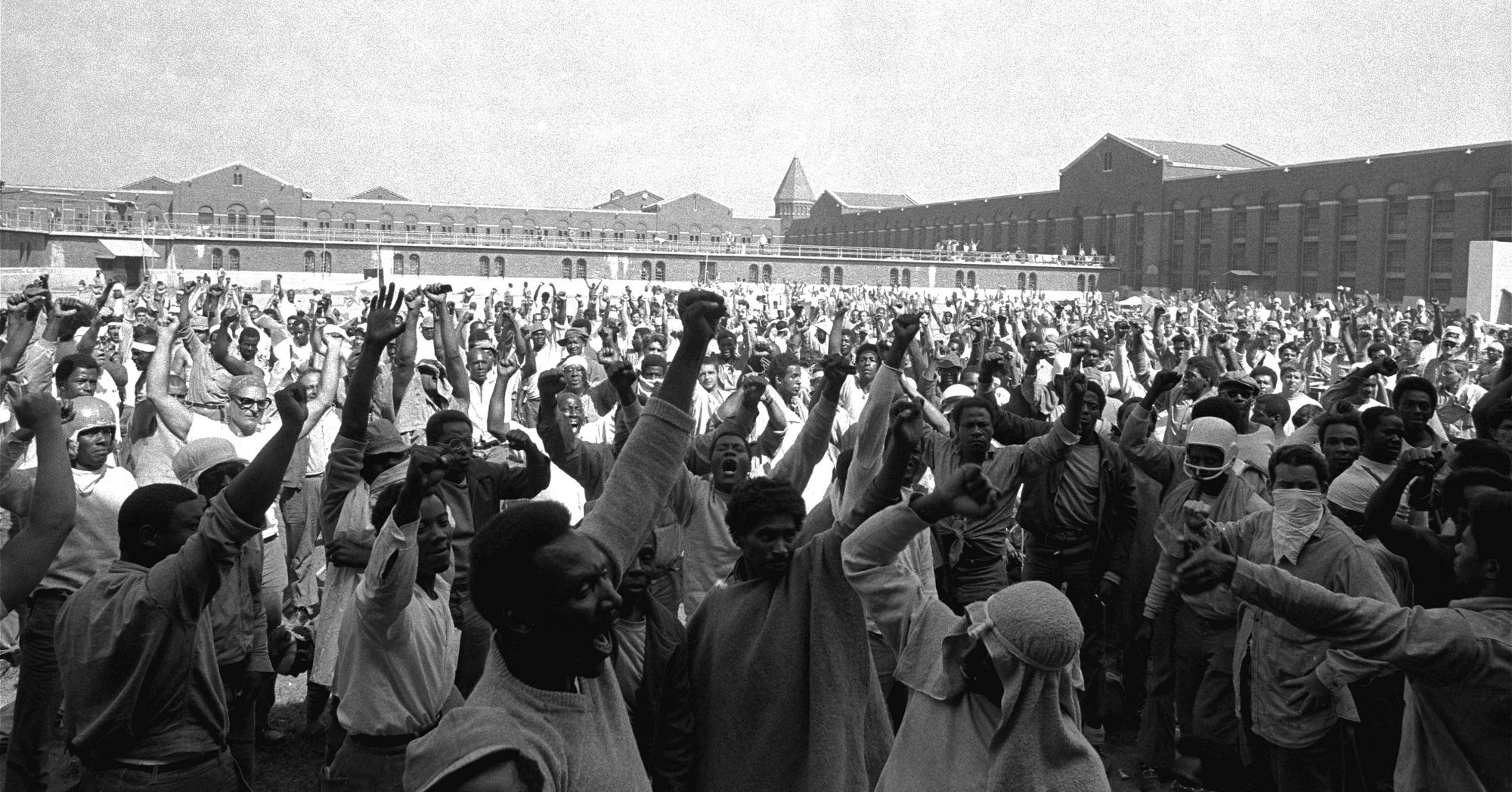
Forced labor has, of course, continued into the modern capitalist era, but not in the form of direct slavery. The most infamous example of this is the policy of mass incarceration10: a policy of social engineering (and reaction to the Civil Rights democratic movement) whereby Black workers were first denied an education and other democratic rights, and thus were first up for the chopping block when technological innovation began to create an army of “unskilled,” “unemployable” labor11. This “army of the unemployed” then became the “army of the incarcerated” in the 70s, who were made to do menial work to sustain and maintain themselves when the crisis-laden capitalist system could not provide employment. Naturally, this quickly evolved into an attached prison-industrial complex, where prisoners are made to work for outrageous wages in the worst conditions – a modern, “impersonal” slavery.
As the MAGA clique of technological capital has begun implementing its program, this fascist power has replaced the traditional subjugation of migrant workers by semi-legality with another direct system of forced labor and prison slavery with ICE. These are the “return” of the worst aspects of the slave system, but under a new, generalized framework. This is the “slavery” brought out by capitalist-imperialist crisis, and which can be defeated, not by liberal-bourgeois revolution, but only by proletarian, working-class revolution.
Since 2008, we have been in a worldwide economic crisis, and more and more, the old capitalist system is grinding to a halt. The objective conditions for revolution are growing quickly. It is up to us, the multiracial and multinational working class, to meet the moment and defend the cause of the working class, to build our own “Underground Railroads” to protect our fellow workers and comrades, and to advocate revolution against the rotten, backwards, and reactionary capitalist system. This Juneteenth, it cannot be the capitalists who lead the way to liberation, but the multiracial, multinational working class.
3 De Ste. Croix, G. E. M. The Class Struggle in the Ancient Greek World from the Archaic Age to the Arab Conquests. Cornell University Press, 1989.
5 Salazar, Manuel. Octubre 17, 2017.
6 Bland, William. “The Formation of the United States,” 1996.
7 Lenin, Vladimir. “Left-Wing Communism: An Infantile Disorder,” USSR, Progress Publishers, 1964. “It is not enough for revolution that the exploited and oppressed masses should understand the impossibility of living in the old way and demand changes; it is essential for revolution that the exploiters should not be able to live and rule in the old way.”
8 But, see Dubois, W.E.B. Black Reconstruction in America, 1935, on the ways the new capitalist alliance brought the more radical, democratic elements of the Civil War to a screeching halt in the aftermath. Compare with the experience of the February revolution (Lenin, Vladimir. “The Task of the Proletariat in the Present Revolution,” 1917), or more recently, the Arab Spring (Boyle, Peter. “Tunisia’s ‘unfinished revolution’ – interview with Workers’ Party militant, Green Left Weekly, 2012.).
9 Anonymous. “Os Negros em os Estados Unidos,” A Luta, 2, Partido Comunista Revolucionaria (Brasil), 1967.
10 Wilson Gilmore, Ruth. Golden Gulag: Prisons, Surplus, Crisis, and Opposition in Globalizing California, University of California Press, 2007.
11 Marx, Karl. “Chapter 10: The Working Day” in Capital: Volume 1, Progress Publishers, 1887.